
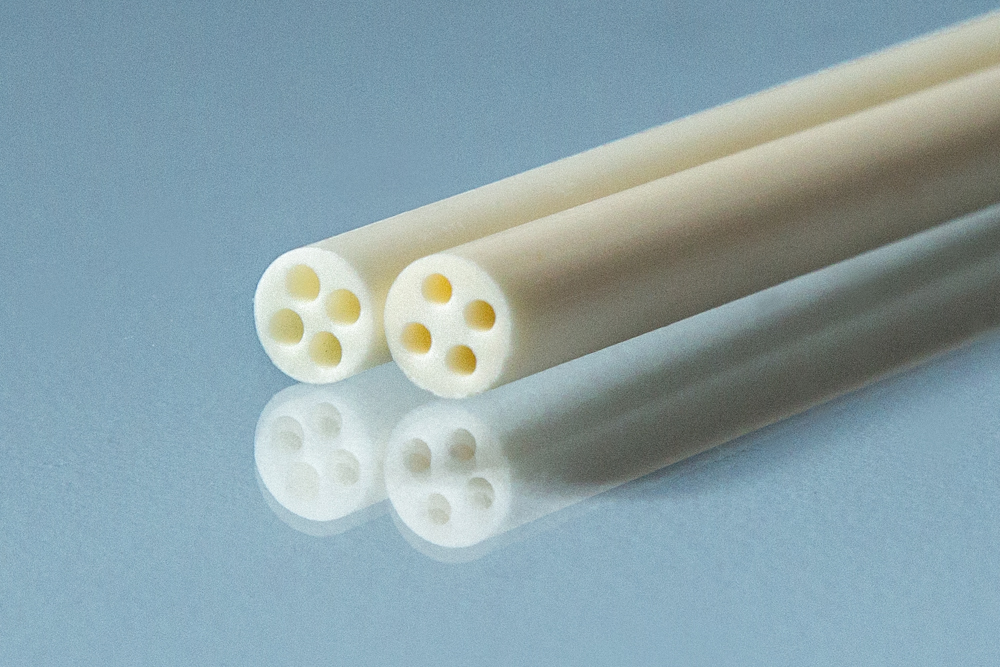
Alumina Four Bore Tubes
| Item # | Inner Diameter | Outer Diameter |
|---|---|---|
| A4B070 | 0.005 in | 0.032 in |
| A4B071 | 0.010 in | 0.047 in |
| A4B072 | 0.016 in | 0.062 in |
| A4B073 | 0.020 in | 0.078 in |
| A4B074 | 0.020 in | 0.093 in |
| A4B075 | 0.020 in | 0.109 in |
| A4B076 | 0.020 in | 0.125 in |
| A4B077 | 0.032 in | 0.125 in |
| A4B078 | 0.032 in | 0.156 in |
| A4B079 | 0.040 in | 0.156 in |
| A4B080 | 0.032 in | 0.188 in |
| A4B081 | 0.040 in | 0.188 in |
| A4B982 | 0.047 in | 0.188 in |
| A4B083 | 0.050 in | 0.219 in |
| A4B084 | 0.040 in | 0.250 in |
| A4B085 | 0.062 in | 0.250 in |
| A4B086 | 0.078 in | 0.250 in |
| A4B087 | 0.062 in | 0.312 in |
| A4B088 | 0.078 in | 0.312 in |
| A4B089 | 0.093 in | 0.312 in |
| A4B090 | 0.125 in | 0.375 in |
| Item # | Inner Diameter | Outer Diameter |
Alumina four bore tubes are engineered for applications requiring four isolated channels within a single ceramic structure. Manufactured from high-purity aluminum oxide, these tubes provide stable performance in environments involving elevated temperatures, corrosive media, or electrical isolation requirements. The multi-channel configuration supports systems that require organized routing of conductors, sensing elements, or controlled media pathways without increasing assembly size or compromising mechanical strength.
Engineers rely on four bore tubes when consistent spacing and isolation between multiple pathways are required. The ceramic material maintains dimensional accuracy across repeated thermal cycles and resists wear in continuous-use environments. With a wide range of inner and outer diameters available, these tubes integrate easily into instrumentation, analytical equipment, heating systems, and chemical processing assemblies. The four-channel geometry supports compact system design while maintaining reliable separation between each bore.
Material Characteristics That Support Multi-Channel Performance
High-purity alumina provides a combination of thermal endurance, dielectric strength, and chemical resistance that supports the performance of four bore tubes. The ceramic structure remains stable at temperatures approaching 1800°C and resists degradation when exposed to acids, halogens, or aggressive process chemicals. Low porosity reduces the risk of permeation, while the multi-channel geometry maintains consistent spacing and isolation between all four pathways.
Typical Uses in Industrial and Scientific Systems
Four bore alumina tubes are commonly used in thermocouple assemblies where multiple sensing elements must be routed in parallel while remaining isolated. Electrical systems use them to separate conductors in compact environments that require reliable insulation and mechanical protection. In laboratory and analytical systems, the tubes support controlled routing of gases or liquids across multiple channels. Heating assemblies and thermal transfer equipment use four bore tubes to manage temperature gradients while maintaining structural integrity.
Advantages of the Four Bore Configuration
The four-channel design provides organized routing within a single ceramic tube, reducing assembly complexity and improving alignment. This configuration supports applications where multiple conductors or media pathways must be isolated without increasing component count. Compared to single or double bore tubes, four bore designs offer greater routing capacity while maintaining a compact footprint. The ceramic structure reduces maintenance requirements and supports long service life in demanding environments.
Alumina Four Bore Tubes FAQ
How Are Alumina Four Bore Tubes Used in Multi-Sensor Systems?
Alumina four bore tubes allow multiple sensing elements to be routed in parallel while remaining isolated from each other. This supports accurate measurement and reduces interference in thermal or analytical systems.
Why Choose a Four Bore Tube Instead of Multiple Single Bore Tubes?
A four bore tube consolidates several pathways into one component, improving alignment, reducing installation time, and minimizing space requirements. It also ensures consistent spacing between channels.
What Makes Alumina Effective for Multi-Channel Insulation?
Alumina provides strong dielectric properties, high thermal stability, and resistance to corrosive media. These characteristics support reliable insulation and protection for multi-channel assemblies.
Can Four Bore Tubes Be Used for Multi-Stream Gas or Fluid Routing?
Yes. The four parallel bores allow controlled routing of gases or liquids while maintaining isolation. This supports laboratory systems, analytical instruments, and controlled-environment processes.