
Pulleys
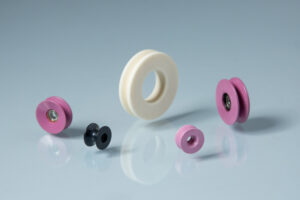
Ceramic pulleys manufactured by LSP Industrial Ceramics provide stable, wear resistant interfaces for applications requiring precise wire routing, filament control, or tension management in demanding environments. These components are used across textile processing, wire drawing, fiber production, cable manufacturing, and high temperature industrial systems where polymer or metal pulleys cannot maintain dimensional stability or resist abrasion.
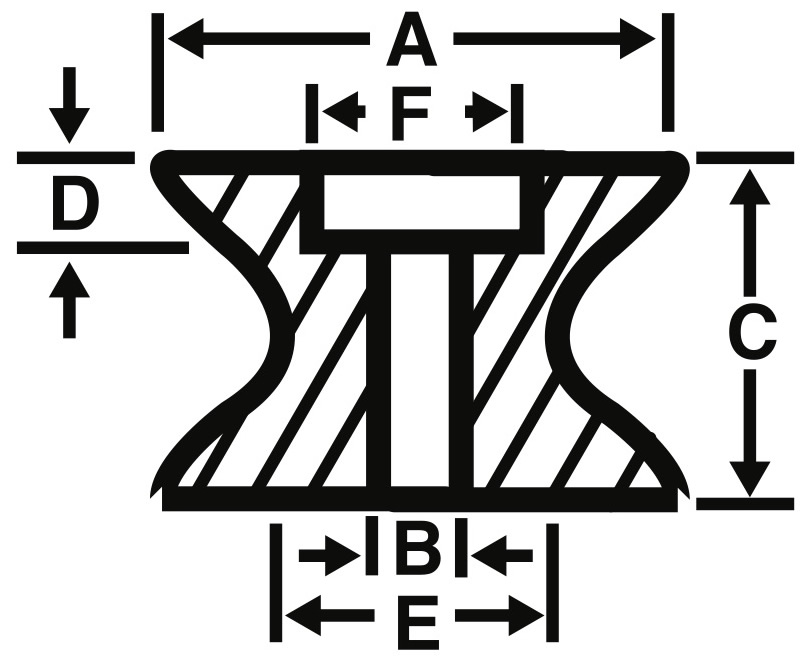
The geometry of a ceramic pulley influences how wire or filament tracks across the groove. Groove diameter, depth, and profile determine how tension is distributed and how consistently the material remains centered during operation. Outer diameter and width influence rotational behavior and compatibility with mounting hardware. Additional features such as flanges, extended hubs, or multi groove configurations support specialized routing paths or multi line systems. LSP Industrial Ceramics manufactures pulleys with tight dimensional tolerances to ensure predictable performance across long production runs, reducing variability and improving process stability.
Material Behavior and Wear Performance in Ceramic Pulleys
Ceramic pulleys maintain structural integrity under continuous abrasion, thermal cycling, and mechanical load. Their hardness resists groove deformation, ensuring consistent tracking over time. Thermal stability allows pulleys to operate in heated environments without expansion or distortion. Dielectric properties support use in electrically sensitive assemblies where conductive components are not suitable.
Geometry Variables That Influence Pulley Selection
Several dimensional factors shape how a ceramic pulley performs in a routing system:
- Groove profile determines tracking behavior and tension distribution.
- Outer diameter influences rotational stability and load capacity.
- Width affects compatibility with mounting hardware and multi line systems.
- Hub or flange features guide alignment and prevent lateral movement.
These variables help engineers match pulleys to specific mechanical, thermal, or electrical requirements.
Integration With Wire Routing Systems and Motion Assemblies
Ceramic pulleys must be matched to the geometry and tension characteristics of the surrounding system. Shaft diameter, bearing interface, and mounting configuration influence how the pulley rotates under load. Proper integration ensures stable tracking, predictable tension, and consistent performance across varied speeds and operating conditions. This is especially important in systems where wire or filament must maintain precise alignment to avoid wear or breakage.
Stability, Tracking Accuracy, and Long Run Reliability
Pulley stability depends on the relationship between groove geometry, outer diameter, and rotational behavior. Ceramic’s dimensional consistency ensures that tracking remains uniform across long production cycles. Resistance to wear and contamination supports reliable operation in abrasive or high temperature environments, reducing downtime and extending component life.
FAQ
How Does Groove Geometry Affect Pulley Performance?
Groove shape influences tracking behavior, tension distribution, and how consistently wire or filament remains centered during operation.
Why Is Ceramic Preferred Over Metal for High Wear Applications?
Ceramic materials resist abrasion, maintain dimensional stability under heat, and provide dielectric properties that metals cannot offer.
What Factors Influence Pulley Integration in Routing Systems?
Shaft diameter, mounting configuration, and rotational alignment determine how the pulley performs under load and at varying speeds.
How Do Dimensional Proportions Affect Tracking Stability?
The relationship between groove depth, outer diameter, and width shapes how the pulley guides wire or filament across long production runs.
Segmenting by dimension will alter the order of part numbers.
| A (in) | A (mm) | B (in) | B (mm) | C (in) | C (mm) | D (in) | D (mm) | E (in) | E (mm) | F (in) | F (mm) | |
|---|---|---|---|---|---|---|---|---|---|---|---|---|
| PL6000 | 0.67 | 17 | 0.244 | 6.2 | 0.433 | 11 | 0.315 | 8 | ||||
| PL6000-1 | 0.552 | 14 | 0.169 | 4.3 | 0.236 | 10 | 0.39 | 10 | ||||
| PL6000-1A | 0.551 | 14 | 0.169 | 4.3 | 0.39 | 10 | 0.39 | 10 | ||||
| PL6000-2 | 0.551 | 14 | 0.165 | 4.2 | 0.39 | 10 | 0.315 | 8 | ||||
| PL6000-3 | 0.587 | 14.9 | 0.303 | 7.7 | 0.788 | 20 | 0.41 | 10.4 | ||||
| PL6001 | 0.591 | 15 | 0.165 | 4.2 | 0.591 | 15 | 0.315 | 8 | ||||
| PL6001-1 | 0.662 | 16.8 | 0.138 | 3.5 | 0.39 | 10 | 0.099 | 2.5 | 0.39 | 10 | 0.39 | 10 |
| PL6001-2 | 0.646 | 16.4 | 0.177 | 4.5 | 0.354 | 9 | 0.346 | 8.8 | ||||
| PL6001-3 | 0.65 | 16.5 | 0.181 | 4.6 | 0.359 | 9.1 | 0.414 | 10.5 | ||||
| PL6001-6 | 0.669 | 17 | 0.197 | 5 | 0.276 | 7 | 0.327 | 8.3 | ||||
| PL6002 | 0.717 | 18.2 | 0.138 | 3.5 | 0.276 | 7 | 0.299 | 7.6 | ||||
| PL6002-2 | 0.717 | 18.2 | 0.142 | 3.6 | 0.343 | 8.7 | 0.374 | 9.5 | ||||
| PL6004 | 0.709 | 18 | 0.201 | 5.1 | 0.315 | 8 | 0.236 | 10 | ||||
| PL6005 | 0.772 | 19.6 | 0.255 | 6.5 | 0.394 | 10 | 0.37 | 9.4 | ||||
| PL6006 | 0.788 | 20 | 0.205 | 5.2 | 0.532 | 13.5 | 0.118 | 3 | 0.39 | 10 | 0.374 | 9.5 |
| PL6006-1 | 0.795 | 20.2 | 0.126 | 3.2 | 0.276 | 7 | 0.118 | 3 | 0.472 | 12 | 0.307 | 7.8 |
| PL6007 | 0.788 | 20 | 0.236 | 6 | 0.39 | 10 | 0.079 | 2 | 0.315 | 8 | ||
| PL6007-6 | 0.787 | 20 | 0.236 | 6 | 0.39 | 10 | 0.354 | 9 | ||||
| PL6008 | 0.796 | 20.2 | 0.177 | 4.5 | 0.433 | 11 | 0.079 | 2 | 0.374 | 9.5 | 0.236 | 10 |
| PL6010 | 0.796 | 20.2 | 0.126 | 3.2 | 0.536 | 13.6 | 0.118 | 3 | 0.406 | 10.3 | 0.307 | 7.8 |
| PL6012 | 0.985 | 25 | 0.248 | 6.3 | 0.709 | 18 | 0.059 | 1.5 | 0.39 | 10 | 0.355 | 9 |
| PL6012-2 | 1.01 | 25.6 | 0.165 | 4.2 | 0.307 | 7.8 | 0.051 | 1.3 | 0.787 | 20 | 0.598 | 15.2 |
| PL6013 | 1.024 | 26 | 0.276 | 7 | 0.591 | 15 | 0.591 | 15 | ||||
| PL6013-1 | 0.984 | 25 | 0.378 | 9.6 | 0.701 | 17.8 | 0.602 | 15.3 | ||||
| PL6013-3 | 0.984 | 25 | 0.39 | 10 | 0.63 | 16 | 0.591 | 15 | ||||
| PL6013-8 | 1.027 | 26.1 | 0.276 | 7 | 0.594 | 15.1 | 0.571 | 14.5 | ||||
| PL6014 | 1.16 | 29.4 | 0.244 | 6.2 | 0.552 | 14 | 0.032 | 0.8 | 0.65 | 16.5 | 0.355 | 9 |
| PL6016 | 1.16 | 29.4 | 0.236 | 6 | 0.552 | 14 | 0.059 | 1.5 | 0.39 | 10 | 0.355 | 9 |
| PL6018 | 1.54 | 39 | 0.418 | 10.6 | 0.63 | 16 | 0.808 | 20.5 | ||||
| PL6020 | 0.65 | 16.5 | 0.181 | 4.6 | 0.484 | 12.3 | 2 grooves | 0.417 | 10.6 | |||
| PL6020-1 | 0.65 | 16.5 | 0.181 | 4.6 | 0.61 | 15.5 | 3 grooves | 0.417 | 10.6 | |||
| A (in) | A (mm) | B (in) | B (mm) | C (in) | C (mm) | D (in) | D (mm) | E (in) | E (mm) | F (in) | F (mm) |